
Table of contents
Retail display boxes are paper-based packaging structures engineered specifically for point-of-sale product presentation. Constructed from corrugated board or rigid paperboard, they take the form of countertop displays, floor-standing display units, or shelf trays that place products directly in front of consumers. They serve two core functions: maximizing visual exposure within limited shelf real estate, and upgrading standard packaging into a sales tool through structural design and brand printing. Whether for convenience-store countertop units, supermarket-aisle floor displays, or boutique custom display boxes, paper-based display packaging is the category that converts packaging cost into sales investment at retail.

Display Box Types: Countertop, Shelf, or Floor
Display boxes are not a single category. They are a family. Different retail environments demand entirely different display box structures. Choose the wrong type and either the display gets blocked by shelf edges, or the structure cannot support the product weight and collapses on the shop floor.
Countertop display boxes: the last three seconds at checkout
Countertop display boxes are the highest-volume category in retail display boxes—small paperboard display units placed at checkout counters, service desks, or cosmetic counters. Typical dimensions stay under 8×6×10 inches, displaying impulse-purchase items such as gum, chocolate, travel-size skincare, and phone accessories. Constructed from corrugated board or rigid paperboard, they use tray-with-backer or tiered-shelf structures.
In our experience, countertop display boxes have a common design trap: the brand artwork looks prominent on the designer’s screen, but from the actual customer’s viewing distance—often beyond three feet—the graphic shrinks into a small color block under perspective. Real countertop display design must test information visibility from both three-foot and five-foot distances. The logo and product category name must remain clearly legible at both ranges.
Floor displays: standalone retail fixtures in corrugated
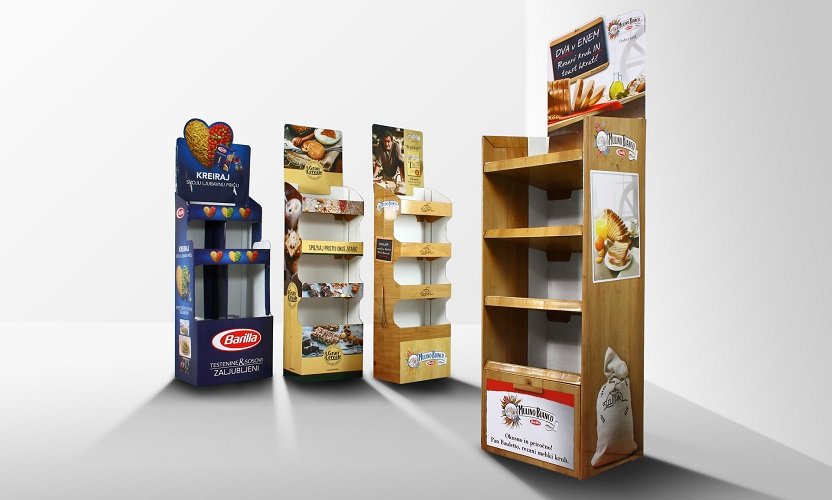
Floor displays are the most ambitious category in paper-based display boxes—a freestanding corrugated structure 48 to 72 inches tall, carrying 20 to 80 pounds of product. Snack brand promotional pallets, beverage seasonal displays, new-book launch stands—these are all typical applications for paper floor displays. Costs range from $15 to $80 depending on size, print complexity, and structural design.
Floor display board thickness typically uses BC-flute or AB-flute double-wall corrugated. Single-wall corrugated cannot support a 60-inch-high, 50-pound structure standing in a supermarket aisle. One mistake we often see is brands underestimating the structural demands. A floor display must stand for 4 to 8 weeks in a busy supermarket aisle, getting bumped by shopping carts, tugged by children, and dragged around by staff. Double-wall corrugated with cross-bracing is the minimum safety configuration for this category.
Shelf trays and shelf-ready displays: packaging that becomes the planogram
Shelf tray displays sit at the intersection of shipping containers and display fixtures. Products are packed into the display at the factory. At the retail endpoint, the top lid or front panel is torn away along a pre-scored tear strip, and the remaining box body becomes the shelf-ready display tray. These display boxes are especially common in supermarket biscuit, confectionery, and convenience-food aisles. The structure uses a pre-cut tear-away front panel that exposes the product while the remaining box serves as the tray.
Shop display boxes in this category deliver one core advantage: they eliminate the secondary shelf-stocking step at retail. Staff do not need to remove products from a shipping carton and arrange them on the shelf individually. They tear the front panel, place the unit, and walk away. For the brand, this means higher planogram compliance—the display arrangement you packed at the factory is exactly what the consumer sees in the store.
Display Packaging Design: More Than a Logo
Display packaging follows a different design logic from standard shipping boxes. A shipping box needs to protect the product and show the brand. A display box must accomplish transport, presentation, and sale within a single structure.
Information hierarchy: what the consumer must see in 3 seconds
Information hierarchy on display boxes is even more unforgiving than on regular packaging. A consumer walking past a shelf scans your display box for 1 to 3 seconds. In those 1 to 3 seconds, they must register three things: what the product is, what brand it belongs to, and why it is worth stopping for.
Specifically, the front face of a display box must place the brand logo and the product category name in the largest, highest position—this is not a printing cost issue but a visual scanning-path issue. Secondary brand information—flavors, sizes, promotional copy—belongs in the lower-middle zone. Many brands assume that making the logo bigger, the colors brighter, and the promo text bolder will capture attention. In practice, added visual noise often backfires. A clean brand logo with 40% white space around it has higher shelf recognition than a layout crammed with competing visual elements.
Display box structural design: transport, display, and consumption in one
Display box structural design faces a built-in contradiction: the box must be strong enough to survive stacking and impact during transit, yet easy enough to convert into a display to minimize retail staff setup time. The solution is pre-scored tear strips and crease lines. During transport, the box is a fully enclosed shipping container. At the retail endpoint, staff tear along the pre-scored line—no tools needed—and complete the conversion from shipping box to display fixture in 10 to 15 seconds.
In our experience, pre-scored line depth is the single most overlooked variable. Too shallow and the tear strip will not tear—staff resort to box cutters and damage the display face. Too deep and the box tears itself open during transit. The correct pre-score depth is 50% to 70% of the board thickness. This parameter needs repeated testing with the factory during the sampling stage.
Display box printing and surface finishing
Display box printing demands are typically higher than standard shipping boxes because these units are viewed, touched, and photographed at close range at retail. Flexographic printing covers one- to two-color display boxes at the lowest cost. Offset litho-lamination on corrugated delivers magazine-grade print precision for categories with high brand-visual requirements—cosmetics, premium food, consumer electronics.
For example, an artisan chocolate brand used litho-laminated countertop display boxes. The chocolate colors reproduced with high fidelity under offset printing. Combined with matte lamination and spot UV gloss, the display units placed on specialty coffee shop counters drove a 28% sales lift compared to the previous flexo-printed standard units over the same period. There is a direct relationship between display packaging print quality and sales conversion—one of the most underestimated ROI metrics in packaging procurement.
Sourcing Display Boxes: Custom vs. Off-the-Shelf
Display box procurement splits into two paths: buying standard off-the-shelf display boxes or commissioning custom display boxes. The cost and applicability differ significantly.
Off-the-shelf display boxes: fast, cheap, limited
Display boxes for sale from supplier inventory come in standard dimensions and standard structures—no cutting die, no sampling, order-to-ship. Unit prices range from $0.50 to $3.00, suiting small-batch trials, temporary promotions, or emergency replenishment. The tradeoff is fixed dimensions and non-adjustable structures. Your product must adapt to the display box rather than the other way around.
Custom display boxes: brand-exclusive, lower long-term cost
Custom display boxes require an initial investment in cutting dies at $100 to $500 and sampling time of 5 to 10 working days. After that, every reorder pays only the box cost itself. Custom display box MOQs range from 300 to 1,000 units depending on structural complexity. In contrast, off-the-shelf display box unit prices appear lower, but your product must conform to a fixed box size. The resulting space waste, display-quality compromise, and increased replenishment frequency often push the total cost of ownership above the custom route over time.
The bottom line: custom display box economics begin to outperform off-the-shelf at monthly usage above 200 to 300 units. Die amortization, improved product presentation efficiency from precision sizing, and brand consistency premium collectively drive total cost 15% to 25% below the off-the-shelf alternative in most cases.
Display box procurement timelines
Standard display boxes ship in 3 to 7 days from domestic inventory, or 5 to 8 weeks from China with ocean freight. Custom display box timelines: design approval to sampling takes 5 to 10 days, sample approval to production completion takes 10 to 18 days, plus ocean freight. Allow a minimum of 6 to 8 weeks of full lead time before a promotional season. We have seen too many brands start ordering display boxes with three weeks remaining before launch, leaving no option but to settle for whatever was in stock.
FAQ
A shipping box has one core function: protection—seal it, ship it, the outside appearance is secondary. A display box must accomplish three tasks within one structure: transport, retail presentation, and sale. During transit it is a box; at the retail endpoint it tears open to become a display fixture. Display box printing requirements are also higher—consumers view them at close range at the shelf, so print precision directly shapes brand perception.
Double-wall corrugated floor displays with BC-flute or AB-flute typically support 20 to 80 pounds of product, depending on shelf count, support structure design, and board weight. A single-wall corrugated floor display should not exceed 15 pounds—the structure gradually deforms under sustained load. For load requirements above 80 pounds, wood or metal reinforcement is recommended.
Simple structures such as countertop tray displays start at MOQs of 200 to 500 units. Floor displays, with their larger individual volume and more complex assembly, start at 100 to 300 units. Digitally printed display boxes have the lowest MOQs—even a few dozen are feasible. Flexo-printed display boxes start at 500 to 1,000 units or above.
Absolutely. Custom display box printing primarily uses flexographic and litho-lamination methods. Flexo suits 1-to-3-color brand printing at the lowest cost. Litho-lamination suits full-color, high-precision printing with the best visual results. Digital printing suits small-batch or market-testing display boxes—no plates needed, though per-unit cost runs higher.
With existing cutting dies, production takes 7 to 12 working days. New die fabrication adds 5 to 10 days. Ocean freight from China adds 3 to 4 weeks to the US West Coast and 5 to 6 weeks to Europe. Floor displays, because of their assembled volume and inability to fold flat, incur significantly higher freight than foldable countertop display boxes—an easily overlooked budget item.
Countertop display boxes use E-flute corrugated or rigid paperboard—low weight capacity, print quality takes priority. Shelf tray display boxes use B-flute corrugated—balancing load capacity with print quality. Floor displays use BC-flute or AB-flute double-wall corrugated—load capacity and structural stability take priority. There is no universal material; material selection must match the display scenario.
Three top offenders. First, information overload—every selling point crammed onto the display face, with the result that consumers absorb none of them. Second, neglecting pre-scored line depth—boxes tear themselves open in transit, or staff cannot tear them open at the store. Third, ordering production quantities without real-world testing. A display box that looks fine at the factory may be blocked by shelf edges, reflect harshly under retail lighting, or deform when bumped by shopping carts in a live aisle. An in-store field test after sampling is inexpensive and prevents large-scale rework costs.