
Table of contents
Cardboard point-of-purchase displays (POP displays) are temporary retail fixtures made from corrugated cardboard. They showcase products at the point of sale and drive impulse purchases. They serve two core functions. First, they capture shopper attention in a crowded retail environment. Second, they convert that attention into immediate purchase decisions. Whether floor-standing promotional towers, countertop units by the register, or seasonal end-cap displays, cardboard POP displays are custom-printed, shipped flat, and assembled on-site.
Types of Cardboard POP Displays
Cardboard POP displays come in several standard formats. Each suits specific retail environments and product categories. Choosing the right format affects both visibility and sales performance.
Floor-standing displays
Floor-standing displays, sometimes called FSDU (free-standing display units), are the largest cardboard display format. They typically stand 48 to 72 inches tall. They occupy roughly 2 to 4 square feet of floor space. These displays work best for new product launches and seasonal promotions. The goal is to stop shoppers and create a destination within the aisle.
In our experience, the most common mistake with floor displays is overloading them. Brands want to showcase their entire product line on one display. The result is visual clutter. A floor display works best when it promotes one hero product with supporting SKUs. It should not try to be a miniature store.

Countertop displays
Countertop displays are compact units for checkout counters, service desks, or shelf tops. They occupy minimal retail real estate. Typical dimensions run 8 to 16 inches wide and 10 to 14 inches tall. These cardboard countertop displays target last-minute impulse purchases. Think lip balms, gift cards, small accessories, and sample-size products.
Corrugated cardboard countertop displays succeed or fail based on restocking ease. A display that is difficult to fill will sit empty. The best countertop units use gravity-fed or angled tray designs. These make replenishment obvious and fast for store staff.
End-cap and aisle displays
End-cap displays attach to or wrap around the end of a store aisle. They serve as a transition between main aisle traffic and a product category. End-cap positions are prime retail real estate. Every shopper walking the aisle passes them. The corrugated display structure must fit standard gondola dimensions. These typically measure 24 to 36 inches wide.
Pallet displays
Pallet displays combine a shipping pallet with a printed corrugated wrap or header. Products sit directly on the pallet they arrived on, ready for display. This format is sometimes called a PDQ (product display quickly) or pallet skirt. Pallet displays work well in warehouse clubs and big-box retailers. The primary advantage is labor savings. Store staff moves the pallet to the sales floor without unpacking individual units.
Dump bins
Dump bins are open-top corrugated containers, typically 24 to 36 inches square and 30 to 40 inches tall. Customers reach in and browse loose products inside. This format suits small, low-cost items where discovery is part of the experience. Examples include packaged snacks, small toys, seasonal candy, and clearance items. Customers spend more time at a dump bin than at structured displays. The digging behavior increases engagement.
Design Principles for Effective Retail Displays
A cardboard display that looks great on screen but fails in-store has not done its job. Retail displays must work under real conditions. They get bumped by carts. They are restocked by staff in a hurry. Shoppers view them from 10 feet away or more.
Visibility from a distance
Shoppers see a display from 10 to 20 feet before they can read details. The header must communicate the offer at that distance. Large typography and high-contrast colors matter more than product information. One mistake we often see is brands treating the header like a brochure. Headers need a single message in large type. They do not need feature lists.
Structural integrity
A corrugated display must survive transportation, assembly, and weeks of customer interaction. Single-wall board (B-flute or C-flute) works for lightweight products and countertop units. Double-wall or triple-wall corrugated supports heavier products and taller floor displays. The design must account for the weight of fully stocked product. The empty display weight is not the relevant number.
Many brands assume a manufacturer will automatically spec the right board grade. In practice, the brand knows the product weight best. Communicating loaded weight during the design phase prevents structural failures. These failures damage both the display and the brand impression.
Assembly speed
Store staff assemble POP displays under time pressure. A display that takes 15 minutes to set up will sit in the stockroom. A display that assembles in under 3 minutes reaches the sales floor. The best cardboard display designs use snap-lock tabs and pre-folded joints. They also include clear printed instructions directly on the display. Complex folding and separate hardware slow everything down.
Shelf-ready design
Shelf-ready packaging (SRP) blurs the line between shipping container and display. A shelf-ready corrugated display ships with product inside. It converts to a display by removing a tear-away front panel. This design eliminates stocking time entirely. The trade-off is visual impact. Shelf-ready structures carry fewer graphics than dedicated displays. The shipper format limits the printable area.
Printing and Finishing for POP Displays
Print quality on a corrugated display affects how shoppers perceive both the brand and the product. Cardboard display printing uses two main approaches. Each has different cost, quality, and production implications.
Litho-laminated printing
Litho-laminated corrugated displays start with offset-printed sheets laminated onto corrugated board. This method produces the highest print quality. The output includes photo-realistic images, fine typography, and consistent color. Litho-lamination is standard for national brands in cosmetics and electronics. Brand image in these categories is non-negotiable.
The cost premium for litho-lamination is significant. Printing plates run $200 to $500 per color. Laminating printed sheets to corrugated board is a separate production step. MOQs for litho-laminated displays start at 500 to 1,000 units. For brands in competitive retail categories, the quality difference justifies the investment. For brands testing a new channel, direct print may be the smarter starting point.
Direct print on corrugated
Direct print applies ink to the corrugated board surface, typically using flexographic or digital methods. Flexo print is most common for volumes above 1,000 units. Flexo plates cost less than offset plates. Typical costs run $50 to $150 per color.
Digital direct print on corrugated eliminates plate costs entirely. It enables full-color printing at quantities as low as 50 to 100 units. Digital quality has improved significantly in recent years. The gap with flexo has narrowed for most retail applications. The key limitation is speed. Digital runs are slower, making them less cost-effective above 500 to 1,000 units.
| Print method | Quality | MOQ | Plate cost | Best for |
|---|---|---|---|---|
| Litho-laminate | Highest | 500–1,000 | $200–$500/color | National brands, premium retail |
| Flexo direct | Good | 1,000+ | $50–$150/color | Mid-volume retail, grocery |
| Digital direct | Very good | 50–100 | None | Test markets, small chains |
Finishing techniques
Corrugated displays use fewer finishing options than rigid boxes. The priority is durability over luxury. Aqueous coating provides scuff resistance during shipping. UV coating on select areas adds visual pop and extra protection. Matte or gloss lamination protects the entire surface. It also extends display life in high-traffic environments.
In our experience, the finishing technique with the highest return is UV coating on the header panel. The header takes the most visual abuse and the most shopper attention. Protecting that single panel returns more value than coating the entire display.
Graphics that work at retail
Retail display graphics follow different rules than packaging graphics. Shoppers see the display from a distance and in motion. Keep the message to three elements: brand, product image, and a single call-to-action. Busy graphics that look impressive on screen become unreadable at 15 feet.
ROI and Cost Analysis for Cardboard Displays
Brands invest in POP displays for one reason: incremental sales. Understanding the cost structure and expected return helps set realistic expectations.
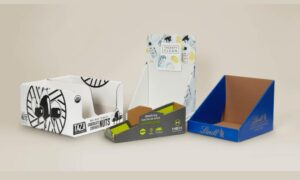
Cost ranges by display type
Cardboard POP display costs vary by size, print method, board grade, and quantity. A countertop unit costs far less than a full floor-standing display with litho-lamination.
| Display type | Cost per unit (1,000 qty) | Cost per unit (5,000 qty) | Typical dimensions |
|---|---|---|---|
| Countertop display | $2.50–$6.00 | $1.80–$4.00 | 8–16″W × 10–14″H |
| Floor display | $8.00–$25.00 | $5.00–$15.00 | 18–30″W × 48–72″H |
| Pallet display wrap | $3.00–$8.00 | $2.00–$5.00 | 40×48″ pallet base |
| End-cap display | $6.00–$18.00 | $4.00–$12.00 | 24–36″W × 54–60″H |
| Dump bin | $4.00–$10.00 | $2.50–$6.00 | 24–36″W × 30–40″H |
Sales uplift benchmarks
Industry data from the PPC and retail studies shows that POP displays generate significant sales lifts. Temporary cardboard displays increase sales by 20% to 60% over shelf placement alone. The uplift is highest for new products and impulse categories. Established staples see more modest gains in the 10% to 20% range.
For a product generating $500 per week in baseline sales, the math is compelling. A $10 display lifting sales by 30% for 6 weeks generates $900 in incremental revenue. At a 40% gross margin, that is $360 in incremental profit. Against a $10 display cost, the ROI exceeds 35x. This calculation explains why retailers keep investing in cardboard POP displays.
Production and shipping timelines
Cardboard display production runs 2 to 4 weeks, depending on print method and order volume. Litho-laminated displays take longer due to the lamination step. Ocean freight from Asia to North America adds 3 to 6 weeks. For seasonal promotions, brands should plan 10 to 12 weeks from order to delivery.
Domestic production with shorter freight compresses the timeline to 4 to 6 weeks for non-litho displays. The unit cost is higher. The speed advantage matters when responding to competitor moves or unexpected demand.
Custom vs Stock Displays: Making the Choice
Brands choose between fully custom corrugated displays and stock display fixtures. Each approach has distinct advantages. The right choice depends on the use case.
Custom corrugated displays
Custom cardboard display stands serve one brand, one product line, and one promotion. Every graphic reinforces the brand identity. The structure fits the product exactly. The trade-off is higher design cost, longer lead times, and minimum order quantities.
Custom displays make sense for national brand campaigns and seasonal promotions with fixed dates. They also suit products with unique shapes that stock displays cannot accommodate. The investment is justified when large numbers of shoppers will see the display.
Stock display fixtures
Stock corrugated displays are pre-designed, off-the-shelf units in standard sizes. They cost less per unit than custom displays. They ship faster because no design or die setup is required. The limitation is branding. Stock displays cannot carry full graphics beyond a printed header card.
Stock displays work for regional promotions and product sampling programs. They also serve as a low-risk entry point for brands testing retail display marketing.
| Factor | Custom display | Stock display |
|---|---|---|
| Brand graphics | Fully custom | Header card only |
| Product fit | Exact dimensions | Standard sizes |
| MOQ | 500–1,000 | 50–200 |
| Lead time | 4–12 weeks | 1–3 weeks |
| Unit cost (1,000) | $6–$25 | $3–$8 |
| Design fee | $200–$800 | None |
Brand Introduction
Hongjia Packaging Technology (Shenzhen) Co., Ltd. manufactures corrugated cardboard displays, retail-ready packaging, and promotional display units. We serve brands across consumer goods, food and beverage, cosmetics, and electronics categories. Our production covers litho-laminated and direct-print corrugated displays in single-wall through triple-wall construction. We support brands with structural design, print production, and logistics coordination. Our displays assemble easily and perform well at retail. For inquiries about custom cardboard POP displays, contact us at alieen170902@gmail.com.
FAQ
Cardboard point-of-purchase displays are temporary retail fixtures made from corrugated cardboard. They sit at the point of sale to promote products and drive impulse purchases. These units range from small countertop displays to full floor-standing structures. Most assemble in minutes and are designed for a single promotional cycle. The primary advantage over permanent fixtures is low cost and full customizability per campaign.
Cardboard display costs depend on size, print method, board grade, and quantity. Countertop displays run $2.50 to $6.00 per unit at 1,000-unit volumes. Floor-standing displays with litho-lamination cost $8.00 to $25.00 each at similar quantities. Larger production runs reduce per-unit cost significantly. Custom design fees, plates, and die-cutting setup add one-time costs of $200 to $800.
Custom corrugated displays with flexo or litho-laminate printing start at 500 to 1,000 units. Digital direct-print displays can be produced in quantities as low as 50 to 100 units. Stock display fixtures are available at even lower quantities. The typical minimum is 50 to 200 units with printed header cards. Per-unit cost is significantly higher at low quantities.
Corrugated displays use three main printing methods. Litho-lamination offers the highest quality with photo-realistic images. Flexographic direct print is most common for volumes above 1,000 units. Digital direct print eliminates plate costs and enables full-color printing at 50 to 100 units. Each method has a different cost threshold where it becomes the most economical choice.
A well-designed corrugated display typically lasts 4 to 12 weeks in retail. Lifespan depends on board grade, traffic level, product weight, and finishing. Double-wall corrugated displays last longer than single-wall units. Aqueous or UV coatings extend surface life against scuffs and moisture. Displays in high-traffic big-box stores wear faster than those in boutique retail.
Yes. Industry data shows temporary cardboard displays lift sales by 20% to 60% over shelf placement. New products and impulse categories see the highest uplift. Established staples see more modest gains. A 10% lift on a $500-per-week product covers a $10 display cost within 2 weeks. The combination of visibility and impulse psychology makes POP displays one of the highest-ROI investments in retail marketing.
Corrugated cardboard is one of the most recyclable materials in retail. A cardboard countertop display from FSC-certified corrugated board recycles through standard cardboard streams. Water-based inks and aqueous coatings support recyclability better than UV coatings or lamination. The key advantage is that the entire display breaks down in a single stream. No material separation is needed.