
Table of contents
Custom corrugated boxes are corrugated paperboard containers purpose-designed and manufactured to match the dimensions, weight, and shipping environment of a specific product. They serve two core functions: protecting the product from compression and impact across the full warehousing and transit chain, and elevating packaging from a brown box to a brand touchpoint through structural design and print. Whether for ecommerce direct-to-consumer, retail distribution, or industrial bulk shipping, the decision to go custom rather than stock is fundamentally a trade of a one-time specification investment for long-term gains in protection and operational efficiency.
Anatomy of a Corrugated Box
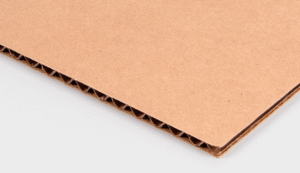
A corrugated box is not made from a single thick sheet of paper. It is a layered sandwich of linerboard, corrugated medium, linerboard. The wavy middle layer, called the flute, is the engineering heart of everything a corrugated box can do.
Flute Types: An Engineering Choice Between Strength and Cushioning
The wavy medium layer inside the board is the flute. Flute height and the number of flutes per meter determine the board’s load-bearing capacity and cushioning properties. Five flute profiles cover most applications:
A-flute is the tallest and coarsest, roughly 110 flutes per meter. It offers the best cushioning, ideal for fragile goods. B-flute is finer, about 150 flutes per meter, with higher flat-crush resistance and better print surfaces. C-flute sits between A and B and is the most common general-purpose flute. E-flute is very fine, around 290 flutes per meter, with a near-solid surface suited for fine printing and folding-carton-style boxes. F-flute is even finer, used mainly for micro-corrugated packaging.
Most custom corrugated boxes use B-flute or C-flute single-wall construction. Those two flute profiles cover the most common product weight range in ecommerce: 3 to 15 kilograms.
Linerboard Grades: From Kraft to White Top
The linerboard determines the box’s appearance and basic surface strength. Kraft liner is the most common, low in cost with good tear resistance, and is the standard brown box material. White Top liner adds a bleached-fiber layer on top of kraft, giving the box a white surface suitable for brand graphics. Printed corrugated cardboard typically uses White Top or coated White Top as the printing substrate.
Linerboard grammage ranges from 125gsm to 300gsm. Higher grammage means a stiffer box and better print results, but also higher material and shipping costs. The key to choosing linerboard is not heavier is better. It is matching the liner to the product weight and protection requirements.
Strength Grades: ECT, Burst, and What You Actually Need
Corrugated box strength is measured by two core metrics: Edge Crush Test (ECT) and Burst Strength. ECT measures how much vertical compression the box can withstand, which determines whether the bottom box in a stack collapses. Burst strength measures the force needed to puncture the board, which determines how the box handles sharp corners and impacts during transit.
Single, Double, Triple Wall: When to Move Up
Single-wall is the most common construction, suitable for most ecommerce and retail packaging under 15 kilograms. One liner, one fluted medium, one liner.
A double wall corrugated box adds a second fluted medium and a third liner, resulting in a three-liner, two-medium structure. It is appropriate for heavy products between 15 and 30 kilograms, high-stacking warehouse environments, and international ocean freight.
Triple-wall is an industrial-grade choice for machinery, automotive parts, and heavy building materials above 50 kilograms. Most brands never need this level. It sits squarely in industrial-packaging territory.
| Wall Count | Weight Range | ECT Range | Typical Application |
|---|---|---|---|
| Single-wall | Under 15kg | 32-44 | Ecommerce parcels, retail outer boxes |
| Double-wall | 15-30kg | 44-61 | Heavy goods, ocean freight, high stacking |
| Triple-wall | 50kg+ | 71-90 | Machinery, industrial shipping |
Do Not Pay for Strength You Do Not Need
One common procurement mistake is upgrading every box to double wall just in case. That just in case doubles the per-unit box cost, adds 15% to 30% to shipping charges, and eats up extra warehouse space.
The right approach is to match wall count to product weight and shipping path. A 3-kilogram beauty product in a double-wall box is waste: single-wall C-flute handles it fine. Conversely, an 18-kilogram motor in single-wall is risk: double-wall is the correct choice.
Special Dimensions: Tall and Long Corrugated Boxes
Standard corrugated boxes have relatively balanced length, width, and height ratios. Many products do not. They are either tall or long. These two cases demand different structural design.
Tall Corrugated Boxes
Tall corrugated boxes have height significantly greater than length and width. Typical products include table lamps, golf clubs, poster tubes, and floor lamps. The structural weakness of tall boxes is vertical stability: the taller the box, the more likely it tips when stacked.
The fix is to increase the bottom-flap overlap area, using full-overlap flaps, or to switch to a double-wall structure for better vertical compression. Another consideration with tall boxes: many automated case sealers have height limits for extra-tall boxes. Above a certain height, boxes require manual sealing.
Long Corrugated Boxes
Long corrugated boxes have length significantly greater than height and width. Typical products include curtain rods, textile rolls, profiles, and door-frame hardware. The structural weakness is in the mid-span: because of the long span, the middle section is prone to bending during handling.
The fix usually involves placing a corrugated partition at the midpoint as structural reinforcement, or increasing liner grammage for greater rigidity. Long boxes also face a shipping challenge: their dimensions often exceed standard parcel-carrier dimensional limits, requiring freight or specialized carrier service. When spec’ing a long custom box, confirm the shipping method before finalizing dimensions. It is cheaper than designing the box first and finding a carrier later.
Surface Treatment and Printing for Corrugated Boxes
Corrugated boxes are not condemned to brown. Printing technology and surface treatment choices determine whether the box stays a shipping container or upgrades to brand packaging.
Flexo Printing: The Native Language of Corrugated
Flexographic printing is the dominant printing method for corrugated boxes. Its advantage lies in cost and volume: flexo runs directly on corrugated board at tens of meters per minute, with no extra lamination, no extra process step. The tradeoff is precision: flexo registration accuracy runs around plus-or-minus 1 millimeter. It cannot do photographic images, but it handles logos, text, and simple graphics perfectly well.
For most custom corrugated boxes, flexo is the practical choice. A brown corrugated box printed with a white logo and basic product information adds under 10% to the cost while transforming the visual from industrial box to branded packaging.
Offset Litho Laminating: When Print Quality Matters
Offset printing delivers far higher precision than flexo: 200-line screen and above, photographic image quality. But offset cannot print directly onto corrugated board. It requires printing the image onto a thin sheet, a litho-label, first, then laminating that sheet onto the corrugated board. This extra step makes offset-litho corrugated boxes 30% to 80% more expensive than flexo.
Printed corrugated cardboard goes offset-litho when the outer box sits on a retail shelf and needs high-impact visuals: think home appliances, premium kitchenware, consumer electronics. In these scenarios, the box is both a protective container and a retail display tool. Print quality directly affects sales conversion.
Digital Printing: The New Small-Batch Option
Digitally printed corrugated boxes need no plates. They go from file to print. Minimum order quantities can drop as low as 50 to 100 units. For small brands testing a market or businesses with frequent SKU changes, digital removes the high setup-cost barrier of both flexo and offset. Digital’s per-unit cost runs higher than high-volume flexo, but total cost is often lower in small-batch runs, because there is no $200 to $500 plate fee to amortize.
Ecommerce and Parcel: Corrugated in the Last Mile
Corrugated boxes are the backbone of ecommerce packaging. But ecommerce corrugated faces a different challenge from industrial corrugated: it must protect the product and make a good impression on the consumer’s doorstep.
Corrugated Box Mailers
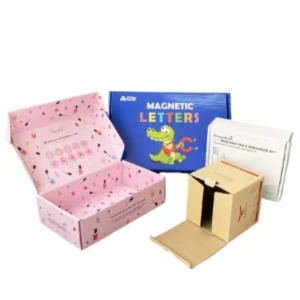
Corrugated box mailers are a specialized flat-profile corrugated box designed for mailing flat items: books, documents, tablets, framed art, apparel. They typically use single-wall E-flute or B-flute and feature a self-locking closure that needs no tape.
The structural design priority for corrugated box mailers is edge protection. Flat items take the most damage at the corners during parcel sorting and delivery. High-quality mailers add corrugated reinforcement strips to all four edges, or optimize flute direction so the board’s bending resistance concentrates on the side that takes the most force.
From a custom-spec perspective, two points matter for corrugated box mailers. First, the mailer dimensions must precisely match the product. Too much void space and the product rattles inside. Too little and it will not fit. Second, the opening design, self-locking tab, tear strip, adhesive strip, directly shapes the customer’s unboxing experience. A mailer that needs scissors to open loses brand points.
Practical Procurement Advice for Corrugated Boxes
Several operational details in procuring custom corrugated boxes are easier to overlook than the box specs themselves, and they tend to create hidden costs once the supply chain is running.
Material Degradation in Storage
Corrugated boxes shipped flat occupy far less space than folding cartons, but corrugated board is more sensitive to humidity than standard paperboard. A corrugated box sitting in a coastal warehouse for three months can lose 15% to 25% of its ECT value. This is why corrugated box procurement should be planned quarterly, not annually.
In our experience, boxes stored below 25 degrees Celsius and 65% relative humidity maintain stable physical properties for six months. Beyond those conditions, the rate of degradation accelerates noticeably. If the warehouse lacks climate control, shortening the reorder cycle is cheaper than upgrading the board spec preemptively.
Dimensional-Weight Shipping
Corrugated box shipping charges factor in both actual weight and dimensional weight. A single-wall box measuring 50 by 40 by 30 centimeters weighs about 0.35 kilograms but carries a dimensional weight of around 3 kilograms. That means the carrier bills at 3 kilograms. For ecommerce direct-to-consumer, every centimeter you can shave off the box dimensions saves money, not on paperboard, but on freight.
Minimum Order Quantities
Custom corrugated boxes typically carry higher MOQs than folding cartons. Flexo-printed corrugated boxes generally start at 1,000 to 3,000 units, because die-cut setup and flexo plate preparation need a reasonable amortization base. Digitally printed corrugated boxes can start at 50 to 100 units, but the per-unit cost runs 1.5 to 2 times that of low-volume flexo. Which path you choose depends on your annual shipping volume.
FAQ
Look at two numbers: product weight and stack height. If the product exceeds 15 kilograms or the warehouse stack exceeds 2 meters, use a double wall corrugated box. Below both thresholds, single-wall C-flute or B-flute usually handles it. An even more direct method: pick up the product in one hand. If it takes serious effort, consider double-wall. If it lifts easily, single-wall works.
At the per-box level, custom runs 20% to 60% more than stock, depending on print requirements and quantity. But factor in packing efficiency and transit protection, and the math can flip. A dimension-matched custom box reduces filler usage, lowers damage rates, and may even reduce dimensional-weight charges. We have seen many cases where the total cost of ownership for a custom box was lower than for a stock box, even though the per-unit purchase price was higher.
Tall-box instability comes from a high center of gravity. Three directions to improve: use full-overlap bottom flaps, switch to double-wall for better vertical compression, or adjust the box footprint to make the base larger and the center of gravity lower. If structural changes are still not enough, consider interleaving the stacking pattern on the pallet instead of straight stacking.
Mid-span support is the key for long boxes. The most effective method is to place a corrugated partition at the midpoint inside the box, with the partition’s flute direction perpendicular to the box’s long side. This gives the partition maximum bending resistance where it matters. If a partition is not feasible because the product fills the interior space, increasing liner grammage is the next-best alternative.
Flexo can print color but cannot achieve photographic quality. Registration accuracy runs around plus-or-minus 1 millimeter. If you need photographic images, you need offset-litho laminating: print the full-color image on a thin litho-label first, then laminate that sheet onto the corrugated board. For printed corrugated cardboard, which path you take depends on the box’s role. If it is just a shipping outer, flexo is enough. If it sits on a retail shelf, offset-litho is worth the extra cost.
Corrugated box mailers are flat-profile corrugated boxes specifically designed for mailing flat items. They typically feature a self-locking closure that needs no tape. They use finer flutes, E-flute or micro-corrugated, giving a smoother surface and a more refined appearance than standard corrugated boxes. Another material and structural difference: mailers generally have better edge reinforcement, because the corners of flat items take the most impact during parcel sorting.
Under ideal conditions, 20 to 25 degrees Celsius, 50% to 65% relative humidity, corrugated boxes maintain stable physical properties for roughly six months. At one year, ECT may drop 10% to 15%. In hot and humid environments, think a non-air-conditioned warehouse in a southern summer, noticeable softening can appear within three months. Purchasing volumes matched to quarterly usage is the safest approach. Order smaller quantities more frequently rather than placing one large annual order that sits in the warehouse.