
Manufacturing Process
The packaging manufacturing process refers to the industrial procedures used to produce custom paper packaging, from design and pre-press preparation to printing, die-cutting, forming, finishing, and quality inspection. Each step is standardized to ensure structural accuracy, visual consistency, and stable performance in mass production.
In custom paper packaging, the manufacturing process integrates material selection, structural engineering, printing technology, surface treatment, and assembly methods. Understanding these processes is crucial for evaluating production feasibility, lead times, quality control, and cost-effectiveness.
*Authority Note *
This section explains packaging manufacturing based on standard factory production workflows used in bulk OEM and ODM paper packaging.
Topics Covered
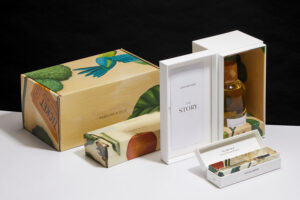
Core Manufacturing Concepts
Prepress and File Preparation
Prepress includes file checking, color separation, imposition, and proofing. It ensures that the artwork is compatible with the printing equipment and accurately defines colors, dimensions, and finishing positions. Most importantly, it confirms that the design is finalized, preventing deviations from the design that could result in cost and time losses.
Printing and Color Reproduction
Offset printing is typically used for high-quality paper packaging, while flexographic printing is used for corrugated cardboard boxes. Color consistency is controlled through standardized ink density, dot gain, and print calibration.
Die Cutting and Creasing
Die cutting forms the flat shape of the box, while creases define the folding lines. The precision of the die design and cutting pressure is crucial for maintaining dimensional accuracy and folding performance.
Gluing and Assembly
Folding cartons and corrugated cardboard boxes are typically formed on automatic gluing lines. Rigid boxes usually require manual or semi-automatic assembly, including packaging, corner forming, and lid attachment.
Manufacturing Perspective
From a factory perspective, packaging production is a controlled sequence of mechanical and manual operations. Production planning takes into account machine capacity, setup times, batch sizes, and process compatibility. Each process step must be aligned to avoid bottlenecks and ensure consistent throughput.
Quality is monitored through in-process inspections, including print color control, die-cutting accuracy, adhesive strength, and surface finish adhesion. Tolerance management is crucial to ensuring that all components fit together correctly in high-volume production.
Standard Industry Definition
The packaging manufacturing process is a series of industrial operations that transform paper-based materials into finished packaging products, including pre-press, printing, surface treatment, die-cutting, forming, assembly, and quality inspection. These processes are standardized to support consistent mass production, structural precision, and functional performance.
Related Knowledge Areas
Packaging Basics
Definitions and fundamentals of custom paper packaging, including basic box types, materials, and applications.
Box Types & Structures
An overview of common packaging box types and structures and their functional differences.
Materials & Surface Finishing
Key packaging materials and surface finishing techniques used in custom paper packaging.
Cost, MOQ & Lead Time
Essential information on packaging costs, minimum order quantities, and production lead times.
Sustainability & Certifications
Sustainable packaging materials and certifications for responsible packaging solutions.
Frequently Asked Questions (FAQ)
What is the first step in packaging manufacturing?
The first step is structural design and prepress preparation, including dieline development and artwork setup.
What printing methods are used for paper packaging?
Common methods include offset printing for high-quality graphics and flexographic printing for corrugated cartons.
What is die cutting in packaging production?
Die cutting is the process of cutting and creasing printed sheets into flat box shapes using steel-rule dies.
How are rigid boxes assembled?
Rigid boxes are formed by wrapping printed paper around greyboard and assembling components manually or with semi-automatic equipment.
How is quality controlled in packaging factories?
Quality control includes material inspection, in-process checks, and final inspection of dimensions, color, strength, and appearance.
What factors affect packaging production lead time?
Lead time is influenced by structural complexity, printing processes, finishing requirements, and production scheduling.
Why Trust This Section
- Based on standard factory production workflows for custom paper packaging
- Written from an industrial manufacturing and process engineering perspective
- Reflects commonly used equipment and quality control systems
- Focused on mass production rather than craft or small-batch processes
- Uses industry-standard terminology and process sequencing
- Intended for brands and businesses sourcing OEM and ODM packaging