
Table of contents
Walk into any jewelry store, and the first thing you notice is not the metal or the stones. It is the moment the sales associate lifts a necklace out of its case and sets it on the counter.
That case—the jewelry box—does more work in three seconds than most brands give it credit for. It signals quality.
It sets the price expectation. It tells the customer whether this piece is a considered purchase or an impulse buy.
For jewelry brands, packaging is not a shipping accessory. It is the only piece of the in-store experience that travels home with the customer.
This guide covers everything jewelry brands need to know about jewelry packaging boxes: wholesale buying strategies, custom design decisions, material selection, and the subtle details that separate premium packaging from forgettable packaging.
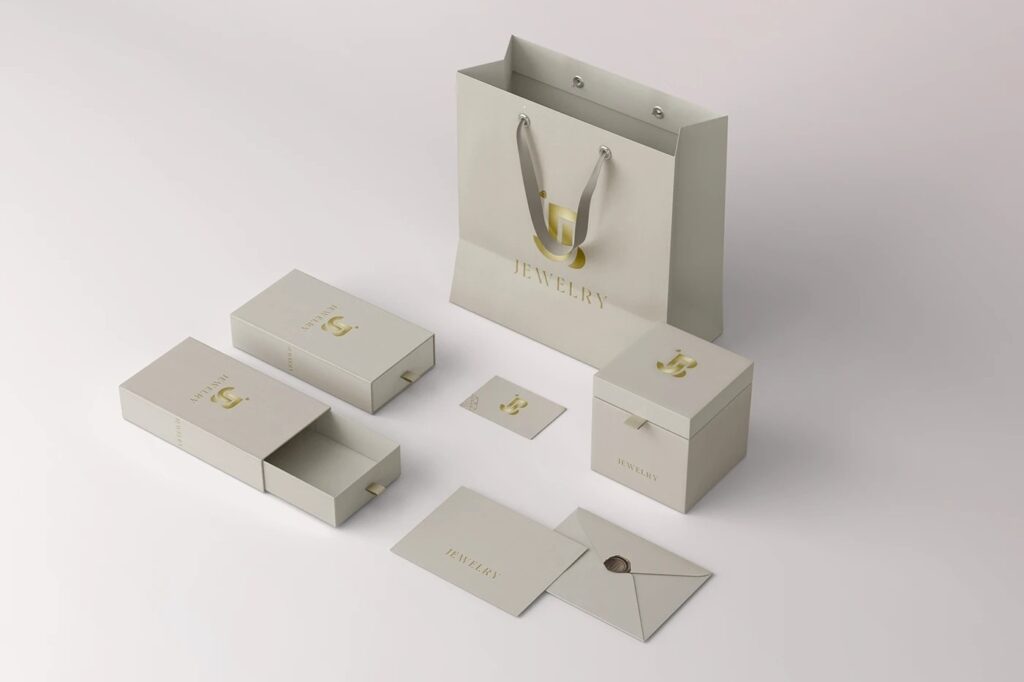
Wholesale Jewelry Boxes: When Standard Makes Sense
Not every jewelry brand needs custom packaging from day one. For many small businesses, wholesale jewelry boxes are the right starting point.
What Wholesale Jewelry Packaging Covers
Wholesale jewelry packaging typically includes stock-size boxes in standard shapes and colors. The most common styles are lid-and-base rigid boxes, folding carton boxes with cotton-filled inserts, and velvet or leatherette-covered hinged cases.
The advantage is straightforward: no minimum order beyond the wholesaler’s shelf stock, immediate availability, and per-unit costs that are hard to match with small custom runs.
A basic leatherette necklace box might run $0.80 to $2.50 at wholesale, depending on size and finish. The same box as a custom order with a logo stamp would double or triple the unit price at low volumes.
When Wholesale Boxes Are Enough
Wholesale jewelry boxes work well for brands that are testing the market, selling at craft fairs and pop-ups, or operating primarily through online marketplaces where packaging plays a supporting role rather than a starring one.
They also make sense for brands that sell at accessible price points—under $50 or so—where custom packaging would eat into margins without a clear return.
The tradeoff: every brand using the same wholesale supplier has access to the same box. There is no visible differentiation, and no brand memory created at the unboxing moment.
Finding Reliable Wholesale Suppliers
Domestic wholesale suppliers generally offer faster turnaround and lower shipping costs. International suppliers—primarily in China and India—offer wider variety and lower unit prices, with tradeoffs in lead time and shipping expense.
When evaluating wholesale jewelry box suppliers, ask three questions: Can they provide material samples before you commit? What is their actual lead time, not their quoted lead time? And can they accommodate a transition to custom production later if your brand grows into it?
Custom Jewelry Boxes: Building a Brand Around the Box
Once a jewelry brand moves past the early stage, custom packaging becomes a competitive asset. The box stops being a container and starts being a brand ambassador.
Custom Dimensions: Fit Comes First
A ring rattling around in a box designed for a necklace is a missed opportunity. The box should hold the jewelry piece without movement, and the insert should cradle it so the first thing the customer sees is the product presented for inspection—not for rescue.
Custom-sized boxes eliminate the filler problem entirely.
For ring boxes, the critical dimension is the insert slot width. For necklace boxes, it is the depth of the bottom tray.
For earring sets, it is the spacing between pairs. Getting these measurements right costs nothing extra in production—it just requires being specific during the design phase.
Custom Materials and Finishes
The material palette for custom jewelry boxes is wider than most brands realize:
Rigid chipboard wrapped in paper or fabric is the standard for premium jewelry boxes. It has weight. It has presence. It does not collapse under the customer’s hand.
Velvet and suede linings are the go-to for fine jewelry. The tactile experience of lifting a ring out of a velvet slot is part of what makes the purchase feel significant.
Leatherette and PU leather offer a premium exterior without the cost of genuine leather. They are durable, available in dozens of colors, and take foil stamping well.
Wood and bamboo bases are gaining traction with sustainable and artisan brands. A bamboo insert inside a kraft paper box tells a story that velvet does not.
Logo and Branding Options
Foil stamping—gold, silver, rose gold, or blind deboss—is the most popular branding method for jewelry boxes. It is subtle, permanent, and looks expensive even when the per-unit cost is modest.
For brands that want more visual real estate, full-color offset printing on the box exterior or interior lid opens up space for pattern designs, brand stories, or care instructions printed elegantly inside the box lid.
Custom ribbon pulls and magnetic closures add functional detail that customers notice and remember.
Materials Deep Dive: Paper, Velvet, Wood, and Beyond
Jewelry packaging materials fall into three tiers based on how they perform at different price points.
Entry Tier: Cardboard and Kraft
For fashion jewelry, costume jewelry, and brands selling under $30, cardboard jewelry boxes with cotton-filled inserts are the most practical choice.
These boxes are lightweight, recyclable, and can be printed with full-color graphics. The cost per unit is typically $0.40 to $1.20 depending on print complexity and order volume.
The key to making cardboard feel intentional rather than cheap is material thickness. A 350gsm paperboard box with a soft-touch matte lamination feels completely different from a 250gsm standard carton.
Mid Tier: Rigid Paperboard with Fabric Wrap
This is where most fine jewelry brands land. A rigid box wrapped in textured paper or linen-finish material, lined with velvet or flocked fabric inside.
Unit costs range from $1.50 to $5.00 depending on size, material, and finish complexity. The perceived value these boxes create supports retail prices from $50 to $500.
The most important decision in this tier is the interior: a flocked tray versus a die-cut foam insert versus a removable velvet pillow. Each creates a different unboxing rhythm, and the right choice depends on how the customer is meant to interact with the jewelry during the reveal.
Premium Tier: Wood, Leather, and Bespoke Construction
For high-end jewelry, engagement rings, and heritage brand packaging, materials move into wood, genuine leather, and handcrafted construction.
These boxes are often designed to be kept—used as a permanent storage solution rather than discarded after purchase. Unit costs start around $8 and can exceed $30 for complex designs.
At this tier, the packaging investment is part of the brand positioning, not a cost to be minimized.
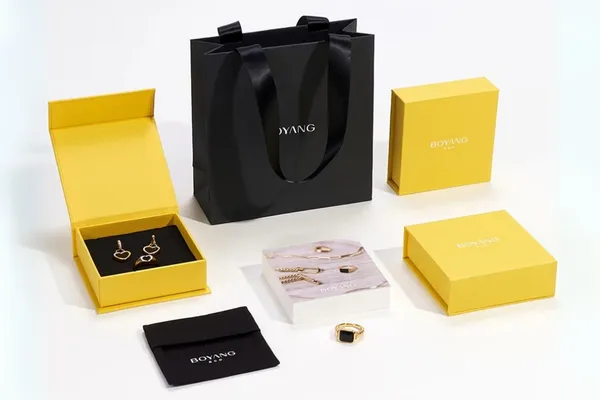
Jewelry Packaging by Product Type
Different jewelry pieces demand different packaging structures. A one-size-fits-all approach leads to loose rings, tangled chains, and lost earring backs.
Ring Boxes
The ring box is the most iconic piece of jewelry packaging and the most functionally demanding. The insert must hold the ring upright and centered, with enough tension to prevent rotation but not so much that it is difficult to remove.
Popular styles include the classic hinged lid box, the slide-out drawer box, and the LED-lit ring box that illuminates the stone when opened. The LED option is especially effective for diamond and engagement ring presentations.
Necklace and Pendant Boxes
Necklace packaging needs to solve one problem above all others: chain tangling.
A padded insert with a dedicated necklace channel keeps the chain straight and the pendant centered. Some designs include a small hook or clip at the top of the insert to hold the clasp in place.
For multi-strand necklaces or sets, tiered inserts with separate channels for each strand prevent chains from intertwining during transit.
Earring Boxes
Earring packaging falls into two categories. Stud earrings need a flat insert with pierced holes or foam slits that hold each pair upright and visible. Drop and hoop earrings need deeper inserts with hanging hooks or clip mechanisms.
Earring sets with multiple pairs benefit from compartmentalized grids that keep each pair isolated and easy to inspect.
Bracelet and Bangle Boxes
Bracelets require wider, flatter boxes with curved inserts that follow the natural shape of the piece. A pillow-style insert works well for bangles and cuff bracelets. Chain bracelets can use a similar channel system to necklace packaging, adjusted for the shorter length.
Jewelry Set Packaging
When packaging a matching set—necklace, earrings, and ring—the box needs dedicated compartments for each piece. A single-level layout with three distinct insert zones is the most common approach. High-end sets sometimes use multi-tier boxes with removable trays for a layered unboxing experience.
Cost and MOQ: What Jewelry Packaging Actually Costs
Jewelry packaging pricing breaks down by production type and order volume.
Off-the-shelf wholesale boxes run $0.50 to $3.00 per unit, with minimum orders as low as a single case pack—typically 12 to 50 pieces.
Semi-custom boxes—stock shapes with custom printing or foil stamping—start around $1.00 to $4.00 per unit, with minimum orders of 100 to 300 pieces.
Fully custom boxes with unique dimensions, custom materials, and multi-process finishing start around $2.50 and can exceed $15.00 per unit. Minimum orders for domestic production typically start at 300 to 500 units. International production runs higher—usually 1,000 to 3,000 units—but drives unit costs down by 40% to 60%.
For most jewelry brands at the growth stage, the sweet spot is semi-custom: a stock box shape with a custom insert, foil-stamped logo, and brand-color exterior. This approach captures most of the branding value at a fraction of the fully custom cost.
FAQ
Domestic manufacturers typically start at 300 to 500 units for fully custom jewelry boxes. Semi-custom options—stock shapes with custom branding—can start as low as 100 units. International suppliers usually require 1,000 to 3,000 units for custom production but offer significantly lower per-unit pricing.
Off-the-shelf wholesale: $0.50 to $3.00. Semi-custom with logo stamping: $1.00 to $4.00.
Fully custom with unique dimensions and materials: $2.50 to $15.00 or higher. The largest cost drivers are material choice, print complexity, and order volume.
Standard custom orders run 2 to 4 weeks for domestic production. International production adds 4 to 8 weeks for shipping. First-time orders with new tooling or custom molds add an additional 1 to 2 weeks.
Yes. Most manufacturers offer sample runs of 5 to 20 pieces for evaluation before full production.
Sample costs typically range from $50 to $300 depending on complexity. The sample fee is often credited toward the full order if you proceed.