
Table of contents
- What Makes a Paper Material Suitable for Food Packaging?
- 1. Folding Boxboard for Retail Food Boxes
- 2. Kraft Paper and Kraft Paperboard
- 3. White Paperboard for High-Quality Printing
- 4. Corrugated Paperboard for Stronger Food Boxes
- 5. Food-Contact Paperboard With Barrier Treatment
- 6. Grease-Resistant Paper: A Critical Point for Food Packaging
- 7. Recycled Paperboard
- Paper Material Comparison for Food Boxes
- How to Choose the Right Paper for Your Food Product
- What Should You Ask a Food Packaging Supplier?
- Can Custom Food Boxes Be Both Functional and Attractive?
- FAQ
Choosing paper for a food box is not simply a question of thickness, color, or price. The right material needs to match the food, packaging structure, printing requirements, moisture and grease exposure, production process, and target market.
For brands ordering custom food boxes, one material may work perfectly for dry bakery products but perform poorly with oily or refrigerated foods. A paperboard that looks excellent on a sample may also need a different coating, barrier treatment, or structure before it is suitable for the intended application.
That is why material selection should happen before the final artwork and production quotation are approved.
This guide compares the most practical paper and paperboard options for food packaging boxes, explains where each material works best, and shows what to discuss with a food packaging supplier before placing an order.
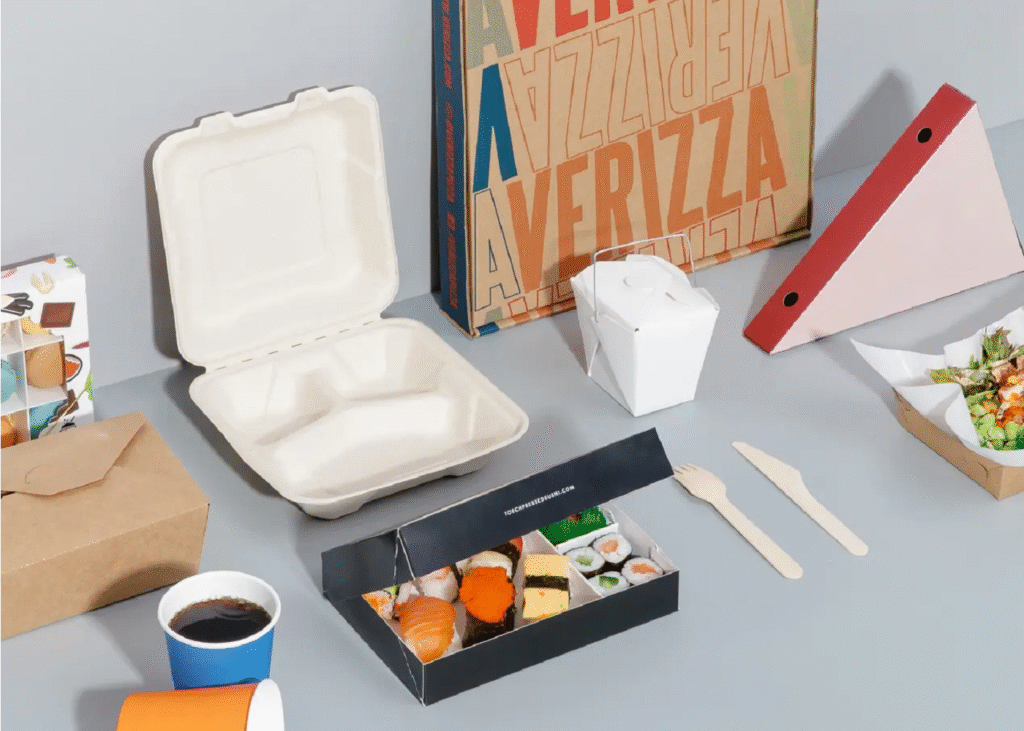
What Makes a Paper Material Suitable for Food Packaging?
Food packaging materials have to do more than hold a product.
Depending on the application, the package may need to provide:
- Structural strength
- Resistance to grease and moisture
- Protection during transportation
- A suitable printing surface
- Appropriate folding and die-cutting performance
- Compatibility with food-contact requirements
- Sufficient rigidity for stacking
- A suitable appearance for the brand
Paper and board are recognized food-contact materials. The European Commission explains that food-contact materials include packaging and that they must be sufficiently inert so that their constituents do not adversely affect consumer health or change the food’s composition, taste, or smell.
In other words, the cheapest paper is not necessarily the most economical choice if the material requires additional treatment or fails to provide the required performance.
1. Folding Boxboard for Retail Food Boxes
Folding boxboard is one of the most versatile materials for retail food cartons.
It is commonly used for:
- Cookies
- Chocolate
- Cereal
- Dry snacks
- Tea
- Confectionery
- Bakery products
- Small gift foods
Its main advantage is the balance between printability, stiffness, folding performance, and material efficiency.
For brands selling food through supermarkets or specialty retailers, folding boxboard also provides a large printable surface for:
- Product photography
- Brand graphics
- Nutritional information
- Ingredients
- Preparation instructions
- Barcodes
- Marketing messages
A well-designed folding carton can therefore function as both a protective package and a retail communication tool.
For custom food boxes, folding boxboard is often the starting point when the product is relatively dry and does not require a heavy barrier structure.
2. Kraft Paper and Kraft Paperboard
Kraft paper is particularly popular for brands looking for a natural or more understated appearance.
It is commonly used for:
- Bakery products
- Takeaway food
- Sandwiches
- Snacks
- Coffee-related products
- Natural or organic-positioned food brands
- Small food gift boxes
The brown appearance of unbleached kraft creates a recognizable visual association with natural materials.
However, “kraft” describes a paper-making material/process rather than automatically meaning that the package is suitable for every food application.
A kraft box may still require an appropriate coating or inner structure depending on whether it contacts:
- Oil
- Water
- Moist food
- Hot food
- Frozen products
This distinction is important when evaluating paper food boxes. A natural appearance does not automatically determine food-contact performance.
3. White Paperboard for High-Quality Printing
White-coated paperboard is a strong choice when graphic reproduction is a major priority.
It provides a clean surface for:
- Four-color printing
- Fine product photography
- Detailed illustrations
- Small text
- Brand colors
- Spot UV
- Foil stamping
- Embossing
For premium confectionery, chocolates, specialty snacks, and gift food products, the visual quality of the outside of the box can be an important part of the product presentation.
If the package needs a highly controlled brand color, white paperboard can also provide a more predictable printing base than brown kraft.
The important point is to separate print performance from food-contact performance. A paper may provide an excellent printing surface without being appropriate as the food-contact layer.
4. Corrugated Paperboard for Stronger Food Boxes
When the box needs greater structural protection, corrugated board becomes more useful.
Corrugated packaging is commonly considered for:
- Larger food products
- Multipacks
- Food delivery packaging
- Bakery boxes
- Subscription food shipments
- E-commerce food packaging
- Products requiring additional transportation protection
The fluted layer creates a lightweight structure with greater resistance to compression and impact than a single flat sheet of paperboard.
The board grade should be selected according to the actual distribution environment.
A box going directly from a factory to a local store has different requirements from one that passes through a fulfillment center, parcel carrier, and customer’s home.
For food packaging boxes, transportation conditions should therefore be considered alongside the food itself.
5. Food-Contact Paperboard With Barrier Treatment
Some foods create a more demanding packaging environment.
Think about:
- Fried foods
- Burgers
- Pastries with butter or oil
- Sauces
- Moist bakery products
- Foods served hot
- Foods requiring resistance to grease or moisture
In these cases, the base paper alone may not provide sufficient performance.
The package may require an appropriate barrier or coating system.
However, this is an area where food-contact compliance becomes particularly important.
The FDA explains that substances used in food packaging can include coatings, adhesives, colorants, and other components that may come into contact with food.
The FDA also maintains specific requirements and food-contact notifications for substances used with paper and paperboard. For example, 21 CFR 176.170 covers components of paper and paperboard used in contact with aqueous and fatty foods.
Therefore, don’t ask a supplier only:
“Can this paper resist oil?”
A better question is:
“What is the complete food-contact construction, and what documentation or testing supports the intended food and conditions of use?”
That distinction can prevent expensive problems later.
6. Grease-Resistant Paper: A Critical Point for Food Packaging
Grease resistance deserves special attention because the regulatory environment has changed.
In February 2024, the FDA announced that PFAS-containing grease-proofing substances were no longer being sold by manufacturers for food-contact use in the U.S. market. In January 2025, the FDA determined that 35 related food-contact notifications were no longer effective.
This matters when specifying grease-resistant paper food boxes.
A supplier should not simply describe a package as “grease-proof.” You should understand:
- What creates the grease resistance?
- Is the treatment intended for food contact?
- What food types is it suitable for?
- What temperature conditions apply?
- Is supporting documentation available?
- Does the construction comply with the destination market?
For U.S.-bound packaging, this is particularly important when developing boxes for oily or greasy foods.
7. Recycled Paperboard
Recycled paperboard can be useful when material sourcing and environmental positioning are important considerations.
It may be appropriate for:
- Dry foods
- Secondary food packaging
- Outer cartons
- Gift food packaging
- Certain retail applications
But recycled content does not automatically mean that every recycled paperboard construction is appropriate for direct food contact.
The actual structure, source material, barrier layer, coating, and intended use need to be evaluated.
For brands making sustainability claims, it is better to describe the actual material and certification rather than simply calling a box “eco-friendly.”
FSC notes that paper and cardboard packaging can be recyclable while also emphasizing responsible sourcing and supply-chain traceability. FSC certification can provide documented chain-of-custody information for certified forest-based materials.
Paper Material Comparison for Food Boxes
| Material | Typical Applications | Main Advantage | Key Consideration |
|---|---|---|---|
| Folding boxboard | Snacks, chocolate, cereal, tea | Good balance of printability and stiffness | Match board construction to food-contact requirements |
| Kraft paperboard | Bakery, takeaway, natural-positioned foods | Natural appearance | Moisture and grease may require additional treatment |
| White-coated paperboard | Premium food, confectionery, retail cartons | Excellent printing surface | Printing surface and food-contact layer are separate considerations |
| Corrugated board | Delivery, multipacks, e-commerce | Higher structural protection | Select flute/grade based on distribution conditions |
| Barrier-treated paperboard | Oily or moist foods | Improved grease/moisture resistance | Treatment must be suitable for intended food contact |
| Recycled paperboard | Selected retail and secondary packaging | Recycled-content options | Direct food-contact suitability must be verified |
There is no single “best” paper material for every food product.
The correct choice depends on the food + contact condition + box structure + distribution environment + market requirements.

How to Choose the Right Paper for Your Food Product
A practical material-selection process starts with five questions.
1. What type of food is being packaged?
Dry biscuits and greasy fried food should not automatically use the same paper construction.
2. Will the food directly contact the package?
If there is an inner bag, liner, tray, or other barrier, the outer carton may have a different material requirement.
3. What conditions will the package experience?
Consider:
- Hot food
- Refrigeration
- Freezing
- Moisture
- Grease
- Condensation
- Long-distance shipping
4. What does the box need to do structurally?
A small folding carton has very different requirements from a large delivery box.
5. Where will the package be sold?
U.S. and European markets have food-contact requirements that need to be considered during material selection.
In the EU, food-contact materials are governed by Regulation (EC) No 1935/2004 and related rules, while GMP requirements are addressed by Regulation (EC) No 2023/2006.
What Should You Ask a Food Packaging Supplier?
When comparing a food packaging supplier, don’t evaluate the quotation based only on paper thickness and unit price.
Ask for information about:
- Paper or board grade
- Grammage
- Food-contact suitability
- Coating or barrier construction
- Printing process
- Adhesive specifications
- Intended food type
- Temperature conditions
- Migration or compliance documentation where applicable
- Sampling
- Production tolerances
- Quality inspection
- Packing and transportation
For example, “350 gsm paperboard” tells you the approximate weight of the material, but it does not tell you whether that construction is appropriate for a greasy food product.
A professional supplier should therefore ask questions about the actual application, rather than simply recommending the thickest available board.
Can Custom Food Boxes Be Both Functional and Attractive?
Yes, and this is where paper packaging has an advantage for many brands.
A properly selected paperboard can support both performance and branding.
Depending on the application, custom food boxes can incorporate:
- Four-color printing
- Matte or gloss finishes
- Spot UV
- Embossing
- Foil stamping
- Die-cut windows
- Locking structures
- Custom inserts
- Folding handles
- Sleeves
The important rule is that decorative processes should not compromise the package’s intended food-contact construction.
For example, a premium chocolate box may use a printed outer carton with foil stamping while keeping the food-contact layer appropriately separated from the decorative surface.
FAQ
There is no universal best material. Folding boxboard works well for many dry-food cartons, kraft paperboard suits many bakery and takeaway applications, while corrugated board is more appropriate when transportation protection is important.
Kraft paper can be used for food packaging, but the specific grade and complete packaging construction must be suitable for the intended food contact. Grease, moisture, temperature, coatings, and other components all need to be considered.
Greasy foods generally require a construction with appropriate grease resistance. The barrier or coating must be suitable for the intended food-contact conditions and destination market. In the U.S., PFAS-containing grease-proofing substances for paper and paperboard food packaging have been phased out as described by the FDA.
It can be suitable for certain applications, but recycled content alone does not establish food-contact suitability. The complete material construction and intended use need to be verified.
GSM means grams per square meter and describes the weight of the paper or paperboard. Higher GSM often indicates a heavier material, but GSM alone does not determine stiffness, strength, barrier performance, or food-contact suitability.
It depends on the product. Uncoated paper can work well for some dry-food and natural-style applications, while coated or barrier-treated constructions may be necessary when moisture, grease, or other demanding conditions are involved.
Provide the food type, product dimensions, approximate weight, direct or indirect food contact, hot/cold conditions, required quantity, box style, target market, artwork requirements, and shipping conditions. These details allow the supplier to recommend a more appropriate paper construction.