
Table of contents
- Start With the Shelf, Not the Artwork
- Choose the Box Structure Before Choosing the Finish
- Use Visual Hierarchy Instead of Adding More Graphics
- Color Should Build a Product Family
- Materials Change How the Design Is Perceived
- Use Finishing to Direct Attention
- Design the Package for Real Retail Conditions
- Leave Enough Space for Required Information
- Consider Sustainability During Structural Design
- What Should You Ask a Cosmetic Packaging Supplier?
- How to Make Luxury Cosmetic Packaging Stand Out Without Overdesigning
- FAQ
A cosmetic product may have an excellent formula, but shoppers often encounter the package before they ever experience the product. On a crowded beauty shelf, packaging has only a few seconds to communicate what the product is, who it is for, and why it deserves attention.
That does not mean cosmetic packaging needs to be complicated or covered with expensive finishes. Effective packaging usually comes from making several decisions correctly: box structure, visual hierarchy, color, materials, finishing, information placement, and shelf visibility.
For brands developing custom cosmetic boxes, the challenge is to create packaging that looks distinctive while remaining practical to manufacture, ship, display, and reproduce consistently.
Start With the Shelf, Not the Artwork
One common mistake is designing the graphics first and thinking about the physical package afterward.
A better approach is to consider the retail environment before finalizing the box.
Ask:
- How large are competing products?
- Will the box stand vertically or horizontally?
- Which panel will customers see first?
- How much information needs to appear on the package?
- Will several product variants be displayed together?
- Does the packaging need to work in both physical retail and e-commerce photography?
The front panel should communicate the most important information quickly.
For many beauty products, the hierarchy might be:
Brand → Product type → Product name → Key benefit → Size or quantity
The exact hierarchy depends on the brand and market, but the principle remains the same: do not make shoppers search for the most important information.
FDA guidance, for example, defines the principal display panel as the part of the package most likely to be examined under customary retail display conditions. Required information must also be presented prominently and conspicuously.
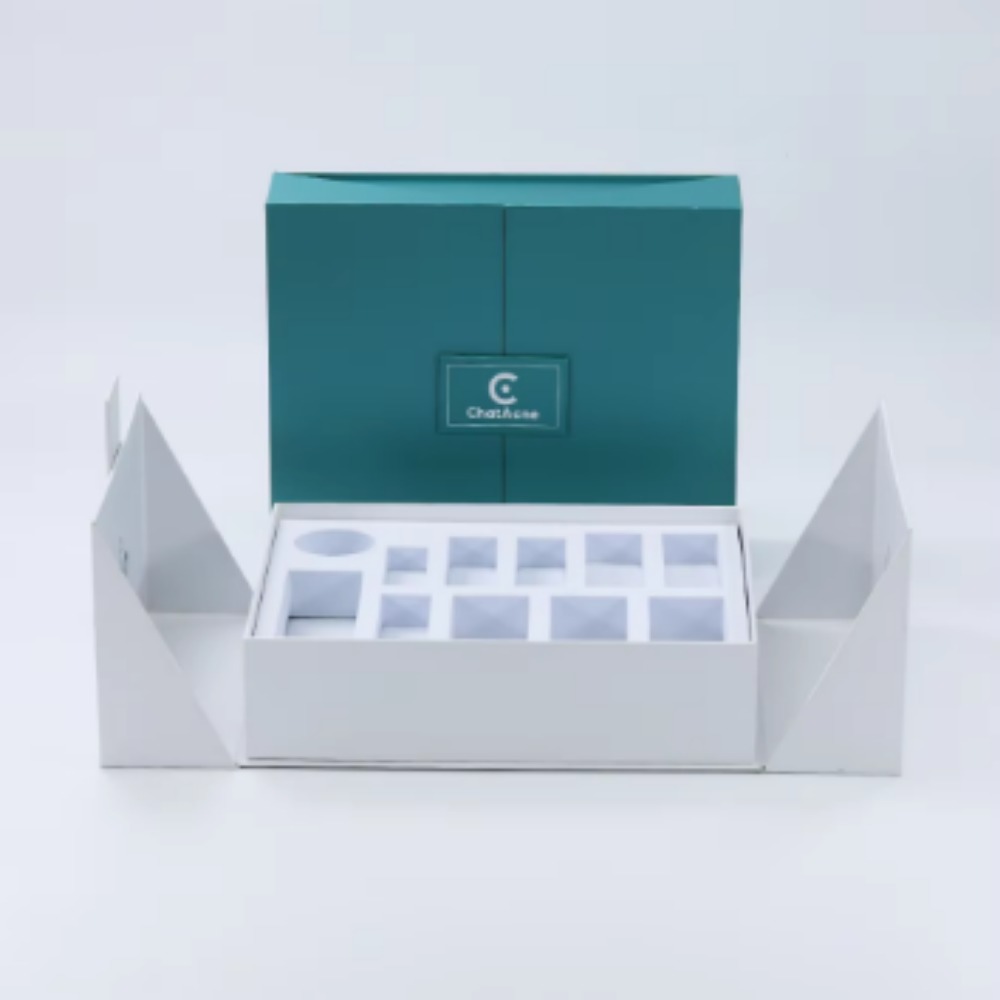
Choose the Box Structure Before Choosing the Finish
Different cosmetic products require different packaging structures. A beautiful finish cannot compensate for a box that is difficult to use or poorly suited to the product.
Folding cartons for everyday cosmetics
Folding cartons are widely used for products such as:
- Foundation
- Lipstick
- Mascara
- Face cream
- Serum
- Cleansers
- Makeup palettes
They are efficient for larger production quantities because they ship flat and generally require less material than rigid boxes.
Common structures include straight tuck end, reverse tuck end, auto-bottom, sleeve-and-tray, and custom die-cut cartons.
For brands launching several SKUs, folding cartons also make it easier to create a consistent packaging family while changing colors, product names, or artwork.
Rigid boxes for premium positioning
Rigid boxes are more appropriate when packaging itself is part of the product experience.
They are commonly used for:
- Luxury skincare
- Premium makeup sets
- Limited-edition collections
- Gift sets
- High-value beauty products
A rigid box provides a more substantial structure and creates more opportunities for special papers, wrapped surfaces, foil stamping, embossing, magnetic closures, and custom inserts.
However, it also normally requires more material, more production steps, and more shipping volume. A premium appearance should therefore be justified by the product’s positioning and price point.
Sleeves and tray structures
A sleeve can create a relatively simple package with a strong visual effect.
For example, a printed sleeve can cover a plain tray while allowing the brand to change the sleeve artwork for different product collections.
This approach can also reduce the need to manufacture completely different rigid structures for every SKU.
Use Visual Hierarchy Instead of Adding More Graphics
When a cosmetic package does not stand out, the instinct is often to add more:
- Patterns
- Decorative illustrations
- Foil
- Text
- Product claims
- Color combinations
This can actually make the package harder to understand.
A stronger approach is to establish three visual levels.
Level 1: What is the brand?
The logo or brand name should be identifiable without dominating the entire package.
Level 2: What is the product?
The product category or name should be immediately understandable.
Level 3: Why should I care?
This can be a product benefit, ingredient story, shade, collection name, or other relevant message.
The goal is not to make every element equally noticeable. Good packaging controls where the eye goes first, second, and third.
This is especially important for cosmetic packaging boxes displayed next to products with very different visual styles.
Color Should Build a Product Family
Color is one of the fastest ways for a beauty brand to establish recognition.
But there is an important distinction between using color for one product and building a complete packaging system.
Suppose a skincare brand has six products. Using six completely unrelated designs may make the range look like six different brands.
Instead, maintain several consistent elements:
- Logo position
- Typography
- Box structure
- Primary brand color
- Graphic language
- Information hierarchy
Then use secondary colors to differentiate product functions or variants.
For example, a consistent white folding carton could use different accent colors for cleanser, toner, serum, and moisturizer.
This approach makes individual products recognizable while keeping the collection visually connected.
Materials Change How the Design Is Perceived
The same artwork can look completely different depending on the paper and board used.
For cosmetic packaging, common options include:
- White folding boxboard
- Coated paper
- Art paper
- Specialty paper
- Greyboard for rigid boxes
- Kraft-based paper for selected brand concepts
Material selection should follow the desired result.
A minimalist skincare brand may benefit from a smooth matte surface and restrained typography. A luxury fragrance or makeup collection may require specialty paper combined with foil or embossing.
For brands emphasizing responsible sourcing, FSC-certified paper and board can provide traceability for forest-based materials. FSC notes that paper and cardboard packaging can be recyclable, while responsible sourcing is important because paper packaging can also be associated with deforestation when materials are not responsibly sourced.
The key is to make a specific material claim rather than simply calling packaging “eco-friendly.”
Use Finishing to Direct Attention
Finishing works best when it supports the design rather than becoming the design.
Foil stamping
Gold, silver, rose gold, or colored foil can highlight:
- Logos
- Product names
- Borders
- Small decorative elements
It works particularly well on dark or specialty papers.
Embossing and debossing
These techniques add physical dimension without necessarily adding another color.
Embossed logos are especially useful when a brand wants a premium tactile experience.
Spot UV
Spot UV creates contrast between glossy and matte areas.
For example, a matte cosmetic box can use spot UV only on the logo or a specific graphic element.
Matte or gloss lamination
Lamination changes the overall visual and tactile character of the package.
Matte surfaces tend to support a softer, more restrained appearance, while gloss surfaces can create stronger color saturation and visual impact.
For luxury cosmetic packaging, combinations such as specialty paper + foil, or matte lamination + spot UV, can create a premium effect without covering the entire box in decorative treatments.
Design the Package for Real Retail Conditions
A package that looks attractive in a design file may perform differently on an actual shelf.
Before approving production, evaluate a physical sample from several angles.
Check:
- Front visibility
- Side-panel readability
- Color consistency
- Logo size
- Text contrast
- Box opening
- Structural stability
- Insert fit
- Surface scratches
- Foil registration
- Die-cut accuracy
This is one reason experienced custom cosmetic boxes manufacturers should be involved before artwork is finalized.
The structure determines the available printable area. The material affects color and finishing. The production process affects tolerances and registration.
Design and manufacturing should therefore be treated as one process rather than two separate stages.
Leave Enough Space for Required Information
A cosmetic package is not purely a marketing surface.
For the U.S. market, FDA requirements include product identity and net quantity on the principal display panel, while other information such as ingredients and business details may need to appear on information panels. FDA states that cosmetic ingredient declarations generally need lettering at least 1/16 inch high, with a 1/32-inch exception for packages with less than 12 square inches of available labeling surface.
For the EU market, Regulation (EC) No 1223/2009 requires cosmetic products to carry specified information, including the responsible person’s details, product function where necessary, and ingredient information.
These requirements affect packaging design directly.
Do not leave the ingredient list, warnings, or other required information until the artwork is nearly finished. Reserve the appropriate information areas at the beginning.
The packaging supplier can help with panel dimensions, printable areas, dielines, and production feasibility, but the brand remains responsible for ensuring its product labeling meets the applicable market requirements.
Consider Sustainability During Structural Design
Sustainability is not simply a question of choosing kraft paper.
The better question is whether the package uses appropriate materials and avoids unnecessary construction.
For example:
- Is the box larger than the product requires?
- Are unnecessary layers being added?
- Can the insert be simplified?
- Is the structure unnecessarily difficult to recycle?
- Are decorative materials being used where they provide little value?
- Can the same structure support multiple SKUs?
This approach can reduce material consumption while also improving logistics efficiency.
For brands selling in Europe, this consideration has become more important. The EU Packaging and Packaging Waste Regulation (PPWR) began applying on 12 August 2026, with requirements covering packaging throughout its life cycle. The European Commission states that all packaging is to be recyclable by 2030, alongside measures addressing unnecessary packaging and empty space.
For international brands, it is therefore sensible to consider the destination market before locking in a packaging structure.
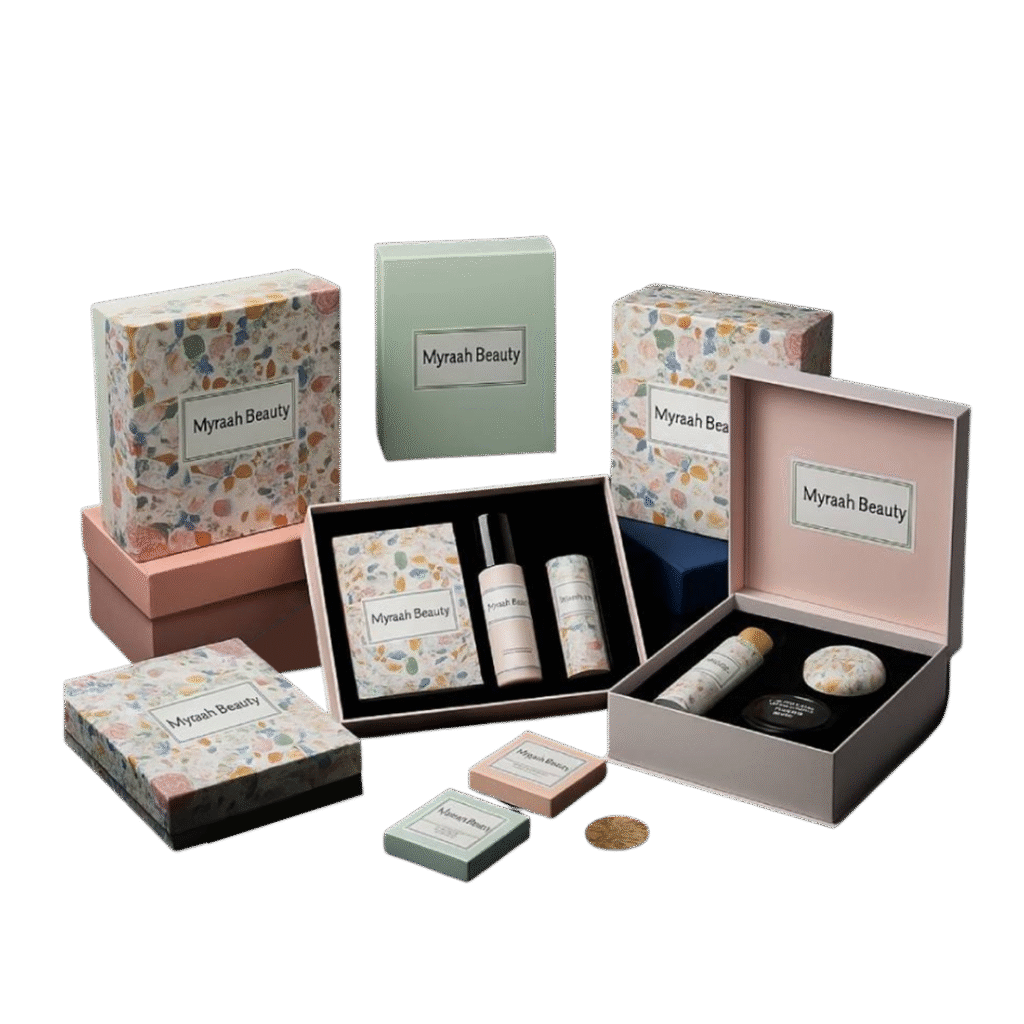
What Should You Ask a Cosmetic Packaging Supplier?
When evaluating a cosmetic packaging supplier, do not look only at the product photos in a catalog.
Ask whether the supplier can support the complete process:
- Structural design and dieline development
- Material recommendations
- Prototype or sampling
- Printing and color management
- Finishing processes
- Insert development
- Quality inspection
- Mass production
- Packing and shipment
- Repeat-order consistency
It is also useful to ask for samples of similar packaging rather than relying only on digital renderings.
A supplier may be able to produce a beautiful sample but struggle with consistency at mass-production scale. For a growing beauty brand, repeatability is often as important as the appearance of the first order.
How to Make Luxury Cosmetic Packaging Stand Out Without Overdesigning
Luxury does not necessarily mean adding more decorative effects.
A premium package can stand out through:
- Better paper selection
- Precise structural proportions
- Strong typography
- Controlled color
- Tactile finishing
- Clean information hierarchy
- Consistent production quality
In our experience, the strongest luxury packaging projects usually have one or two clear visual signatures rather than five or six competing effects.
For example, a simple rigid box with dark specialty paper and a precisely registered foil logo may communicate more premium value than a box covered with multiple unrelated finishes.
The objective is not to make the package look expensive.
The objective is to make it look intentional, recognizable, and appropriate for the product.
FAQ
Start with clear visual hierarchy rather than adding more decoration. Brand recognition, product identity, color differentiation, and readable key information should be established before selecting premium finishes.
Folding cartons are commonly suitable for everyday retail cosmetics because they are efficient for production and shipping. Rigid boxes are more suitable when the packaging experience and premium presentation are important, such as luxury collections and gift sets.
Common paper-based materials include folding boxboard, coated paper, specialty paper, kraft paper, and greyboard for rigid boxes. The appropriate material depends on the product, structure, printing requirements, finishing, and target price.
Yes. Foil stamping can emphasize logos or product names, while embossing adds tactile dimension. They are particularly useful when developing luxury cosmetic packaging, but should be integrated into the overall design rather than used simply for decoration.
The front should normally prioritize brand, product identity, and the most important product message. Required information such as ingredients and other regulatory details should be planned into the appropriate information panels rather than overcrowding the main display panel.
Yes. Brands can consider paper sourcing, material efficiency, box dimensions, inserts, finishes, and recyclability when developing the structure. FSC-certified paper can also provide documented responsible-sourcing information where applicable.
A packaging supplier will normally need the product dimensions, quantity, preferred box structure, material preference, artwork if available, finishing requirements, target market, and shipping requirements. Product photos or an existing package sample can also help the supplier recommend a suitable structure.